Block Blitz: Puzzle Adventure
- 4.7
- Rating
- 1.00M
- Installs
- Free
- Price
 Analysis by App-foxy
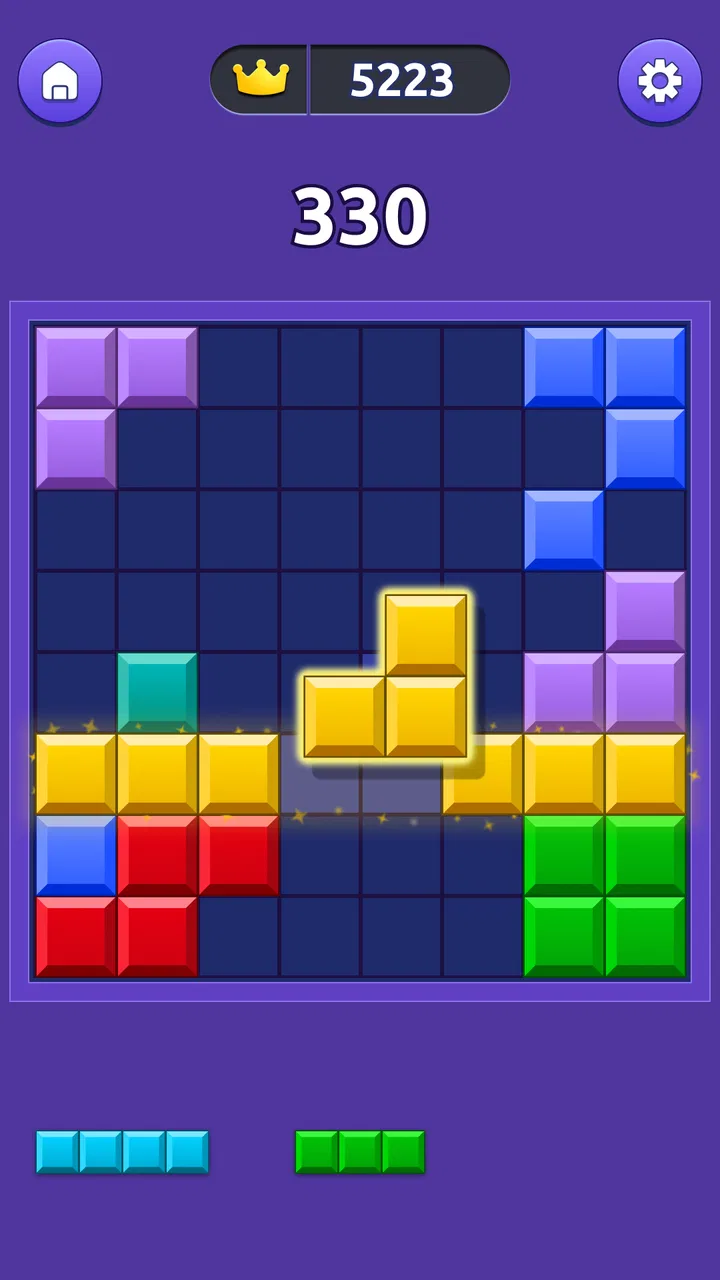
I found Block Blitz: Puzzle Adventure most appealing as a short-session puzzle game rather than a title designed to hold my attention for an entire evening. Its basic promise is easy to understand: place blocks, react quickly, and keep the board under control. That simplicity is exactly where its charm lies. I can open it during a spare minute, play without preparing for a complicated story or rule set, and stop when I need to move on.
That does not mean the game is shallow in every situation. The pressure comes from making small decisions before the available space becomes awkward, and those decisions become more interesting when I stop treating each move as an isolated placement. I have to think about the next few possibilities, protect useful gaps, and avoid filling the board in a way that leaves me dependent on one lucky shape. For me, that makes it a pleasant mix of quick reflexes and light planning.
It is a free puzzle game from Bluetile, rated for Everyone, and it has already passed one million installs. The overall audience response is strong, with a 4.7 average from roughly sixty-three thousand ratings. Those figures fit my impression: this is an accessible game with a broad appeal, not a niche puzzle built around difficult rules or specialist knowledge.
You May Also Like

 Blood Strike: 2.5 Anniversary
Blood Strike’s Loadouts Turn Every Drop Into a Tactical Gamble
A close look at Blood Strike’s custom loadouts: how fast access to signature weapons reshapes its battle royale rhythm, rewards preparation, and narrows the gap between fights.

 Pandora - Music & Podcasts
Pandora’s Music Is Easy to Start, but Harder to Recover
Pandora’s strength is its low-effort path from a seed to a station. Its weak spot is how much confidence it asks you to place in connection, setup, and quiet recovery.

 8 Ball Pool
 Is Built on Rivalries, Rematches, and Routine
A close look at the rivalries, rematches, shared routines, and unanswered safety questions that turn a quick pool match into a persistent mobile community.

 Samsung Music
’s Quiet Strength Is Playing What You Already Own
Its reach comes less from spectacle than from dependable access to a personal library. That simplicity is both the app’s strongest retention engine and its ceiling.

 AccuWeather: Weather Radar
AccuWeather Review: A Quick, Clear Forecast for Everyday Decisions
For everyday plans, the best forecast is the one you can understand quickly. AccuWeather makes rain timing, radar, and local conditions easy to act on, with a few trade-offs.

 Hill Climb Racing
Why Hill Climb Racing Still Turns Crashes Into One More Run
A tiny car, a bumpy hill and one more upgrade: Hill Climb Racing keeps resurfacing because its simple chaos makes every near-miss feel personal.
More From Our News Desk



Why the simple block format works so well
The best part of playing is the speed at which the game becomes understandable. I do not need a tutorial-heavy introduction to know what I am trying to do. The block-puzzle format communicates its objective through the board itself, so I can begin making decisions almost immediately. That is especially useful when I want something to do while waiting for transport, taking a short break, or winding down before sleep.
The quick format also makes failure less frustrating than it can be in longer puzzle games. A poor round feels like a mistake I can learn from rather than a large investment of time lost at once. I can look back at the board and usually identify the problem: I used space too casually, reacted only to the current piece, or created a corner that became difficult to use. That sense of responsibility is important because it keeps the result from feeling entirely random.
I recommend leaving a little mental space between rounds instead of immediately tapping into another attempt. A few seconds spent noticing how the board became crowded can improve the next run more than playing on autopilot. My most useful habit was to treat open areas as future options rather than empty space waiting to be filled. That small change made the game feel more strategic without making it slower.
Another strength is how well the central idea survives short play sessions. Some puzzle games need a long uninterrupted run before their systems become satisfying. Here, even a brief attempt can have a clear beginning, middle, and end. I can make a handful of careful placements, encounter a difficult board, and finish with a sense that the session had a purpose. It is a good fit for people who want a compact mental exercise rather than a large commitment.
Small decisions matter more than fast tapping
The name may suggest that speed is the whole point, but I found that rushing is often the easiest way to lose control. Fast placement feels productive at first, yet it can leave awkward gaps and reduce the number of useful ways to handle the next block. The strongest approach is usually a balance: move promptly when the choice is obvious, but pause when a placement changes the shape of the entire board.
I also learned not to chase an immediately attractive arrangement if it damages the remaining room. A move that appears to complete a neat section can be worse than placing a less convenient piece somewhere that preserves flexibility. This is one of the more valuable lessons the game offers. It rewards thinking about the board as a changing workspace, not as a series of separate targets.
For a more relaxed session, I use the first part of a round to create room and observe how the available shapes interact. I avoid making the board look tidy merely for the sake of appearance. Later, when space becomes more limited, that earlier restraint gives me more choices. This is not a hidden mode or a special technique; it is simply the kind of practical decision-making that becomes apparent after several attempts.
Where it stands beside familiar puzzle alternatives
Compared with traditional falling-block games, Block Blitz feels less dependent on memorizing a fixed rhythm. I am not only reacting to pieces arriving in a predictable vertical stream. The challenge is more about choosing where each shape belongs and preserving room for future decisions. Players who enjoy the classic falling-block formula may miss its distinctive tempo, while people who prefer calmer placement puzzles may appreciate the greater control.
It also differs from match-based puzzle games. There is no need to search for colorful combinations or plan a chain in the same way. The satisfaction comes from spatial organization and avoiding self-created traps. If I want animated effects, character progression, or a puzzle built around a narrative campaign, this is not the alternative I would choose. If I want a clean board challenge that can be understood quickly, its narrower focus is an advantage.
Against slower logic games, the trade-off is equally clear. Those games may offer more time to calculate and more elaborate problem structures. Block Blitz instead creates tension through limited room and quick decisions. I would choose it for a short break, but I would choose a dedicated logic puzzle when I want a quiet, methodical challenge that can occupy me for a longer period.
The main weakness is repetition over longer sessions
My biggest reservation is that the central action can begin to feel repetitive if I play for too long without a break. The block-placement idea is enjoyable, but it does not automatically provide the variety of a large puzzle campaign. After several rounds, I may notice that I am repeating the same broad habits: preserve room, avoid awkward gaps, and recover from a bad arrangement. That loop is satisfying in small doses, yet it can lose some impact during an extended session.
This limitation matters most for players who expect constant novelty. Someone looking for new mechanics, a developing story, or a large collection of puzzle types may find the experience too focused. I would not install it expecting a deep adventure despite the title. Its adventure is better understood as the evolving challenge of surviving one board after another, not as a narrative journey with characters and plot.
The free entry point is welcome, but the game includes in-app purchases priced from $2.49 to $4.99 per item. That does not prevent me from trying it, though it does mean I would pay attention to the purchase prompts and decide in advance whether optional spending fits my habits. For a casual player, I would start with the free experience and avoid buying anything until I knew the basic loop still felt enjoyable after repeated sessions.
There is also a practical device consideration. The game supports Android 7.0 and later, which covers many devices but does not make it suitable for every older phone or tablet. On a compatible device, its quick format makes it easy to keep available for spare moments. Before recommending it to someone using an older Android device, I would check that the operating system meets that requirement rather than assuming every phone can run it.
Who will get the most from it
I think it is particularly well suited to players who like puzzles that explain themselves. You can hand it to someone who does not normally play games and they can understand the basic activity quickly. The Everyone rating also reflects that accessible presentation, although the rating should not be mistaken for a promise that every player will enjoy the pressure of limited space.
It works well for people who want a mental reset during the day. Imagine waiting for an appointment with ten minutes to spare: a round gives you something active to focus on without requiring a long story recap or a complicated control scheme. When the appointment begins, you can put it down without worrying about losing a large amount of progress in a campaign. That convenience is one of its strongest everyday uses.
I would also suggest it to players who enjoy improving through repetition. The game gives you a clear reason to try again: not simply to pass time, but to make fewer careless placements and preserve options for longer. If you enjoy noticing your own habits and gradually becoming more disciplined, the short rounds can be surprisingly rewarding.
On the other hand, I would steer away from it if your ideal puzzle game depends on a rich story, a large set of handcrafted stages, or a strong social component. I would also hesitate to recommend it to someone who dislikes time pressure or becomes irritated by restarting after a crowded board. A slower, turn-based logic game would be a better choice for that person because it allows more deliberate calculation and usually offers a clearer sense of individual puzzle completion.
Useful habits for getting better without turning it into work
My first practical tip is to stop filling the easiest-looking area automatically. An open space can be valuable because it accepts several possible shapes, while a narrow pocket may accept only one. Before placing a block, I ask which areas will remain usable afterward. This question is more helpful than simply asking whether the current piece fits.
My second tip is to avoid building a board that depends on a single future shape. If a placement creates a gap that only one kind of block can solve, it may be worth choosing a less tidy arrangement instead. Flexibility is usually more valuable than immediate neatness. This is the kind of trade-off that separates a lucky round from a controlled one.
Third, I recommend changing your pace as the board develops. Early moves are a good time to establish room and avoid unnecessary congestion. Later moves deserve more attention because one careless placement can remove several options at once. Playing every move at maximum speed may feel exciting, but it makes the game more dependent on impulse than judgment.
Finally, use short sessions as a feature rather than trying to force marathon play. When I stop after a few focused rounds, I return later with better attention and less frustration. The game is at its best when it acts like a compact puzzle break. Treating it as an endless primary game exposes the repetition that is easier to overlook when each session has a clear limit.
What the current release means for new players
The current version is 2.2.0, and the game has been available since September 1, 2025. For someone deciding whether to try it now, the important point is that this is an established release rather than a concept I would approach only out of curiosity. I still judge it by the moment-to-moment puzzle loop, because that is where the value is, but the version detail is useful when checking compatibility and deciding whether your device is ready for installation.
Because the game is free, I see little reason to overthink the first step. Install it, play several short sessions, and pay attention to whether the pressure feels motivating or tiring. The rating and large install base suggest that many players find the format approachable, but my experience is that puzzle preferences are personal. A strong public response cannot replace the simple test of whether you enjoy arranging blocks under increasing spatial pressure.
I would also keep expectations realistic about what “brain training” means here. The game encourages planning, spatial awareness, and restraint, but it is not a structured course or a measured training program. I enjoy it as a playful way to exercise those habits, not as a substitute for a dedicated educational tool. That distinction helps keep the experience enjoyable and prevents the store-style promise of a quick mental workout from becoming an unrealistic expectation.
My recommendation after spending time with it
Block Blitz: Puzzle Adventure succeeds because it knows how much game it needs to be. It gives me a clear spatial problem, enough pressure to make each placement matter, and a session length that fits naturally into everyday gaps. Its strongest quality is not complexity; it is the way a simple board can turn a few spare minutes into a focused challenge.
The limitations are just as clear. The loop may feel repetitive during long sessions, players seeking story or broad mechanical variety will find it too narrow, and the optional purchases are worth approaching thoughtfully. None of those issues ruins the experience, but they define the audience. I would not recommend it as a replacement for every kind of puzzle game.
My final recommendation is straightforward: try it if you want a free, accessible block puzzle for short bursts and gradual improvement. I would especially suggest it to casual players, commuters, and anyone who enjoys learning from their own mistakes. If you prefer elaborate campaigns, slow logic problems, or constant new content, choose a different puzzle style. For the right player, though, Bluetile has made a compact game that is easy to start, satisfying to revisit, and pleasantly demanding without becoming difficult to understand.
FAQs for Block Blitz: Puzzle Adventure
01What is Block Blitz: Puzzle Adventure about?
Block Blitz: Puzzle Adventure is an engaging puzzle game where players must strategically place blocks to clear lines and progress through challenging levels. The game combines elements of classic block puzzles with unique twists, offering a fresh and exciting experience. Players can enjoy various modes, including timed challenges and endless play.
02Is Block Blitz free to play, or are there in-app purchases?
Block Blitz: Puzzle Adventure is free to download and play. However, it offers in-app purchases that allow players to unlock extra features, such as additional lives, special power-ups, and ad-free gameplay. While these purchases enhance the experience, they are not necessary to enjoy the core gameplay.
03Does Block Blitz require an internet connection to play?
Block Blitz: Puzzle Adventure can be played offline, making it perfect for on-the-go entertainment. However, an internet connection is required for certain features, such as online leaderboards and syncing progress across devices. Players can enjoy the main game modes without needing to be online.
04What devices are compatible with Block Blitz: Puzzle Adventure?
Block Blitz: Puzzle Adventure is available on both Android and iOS platforms. It supports a wide range of devices, but for optimal performance, it's recommended to have a device running Android 5.0 or iOS 10.0 and above. Ensure your device has enough storage for smooth gameplay.
05How does Block Blitz handle player data and privacy?
Block Blitz: Puzzle Adventure takes player privacy seriously. The app collects minimal data necessary for improving gameplay and providing personalized experiences. It adheres to strict privacy policies and complies with data protection regulations. Players can find more details in the app's privacy policy section.
Pros
- Engaging puzzles with increasing difficulty.
- Vibrant graphics enhance gameplay experience.
- Intuitive controls for seamless play.
- Regular updates with new levels.
- Offline mode available for on-the-go play.
Cons
- In-app purchases can be pricey.
- Occasional ads interrupt gameplay.
- Battery drain on longer sessions.
- No multiplayer mode available.
- Limited customization options.

Block Blitz: Puzzle Adventure
Gallery